Affiliate disclosure: This article contains affiliate links to eBay. As a participant in the eBay Partner Network, GrailStitch may earn a commission if you click a link and make a purchase, at no extra cost to you.
How to Date Vintage 1990s Nike Air Max Sneakers (90, 95, and 97): Tongue Tags, Factory Codes, and Midsole Hydrolysis
By GrailStitch Editorial, published , 5 min read
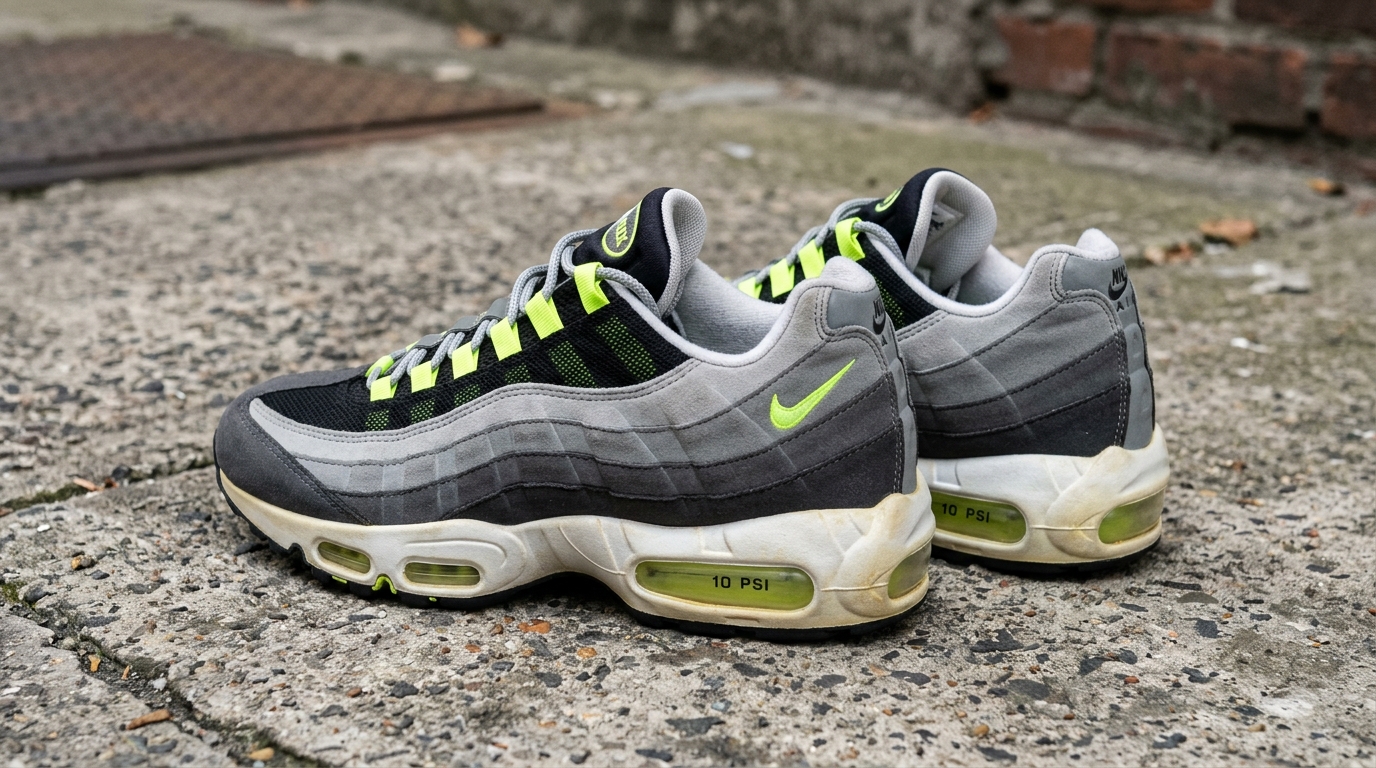
Between 1990 and 1999, Nike transformed running footwear with visible Air technology—launching icons like the Air Max 90 (Air Max III), Air Max 95, and Air Max 97. Because Nike has retroed these silhouettes dozens of times over the past twenty-five years, buying an original 1990s release on the secondary market requires knowing how to decode Nike’s 1990s size tag format, verify original Air unit details, and evaluate polyurethane midsole stability before committing to a purchase.
Quick Reference Matrix: 1990s Nike Air Max Models & Identification Clues
Use this comparison table to distinguish original 1990s Air Max releases from modern retro editions:
| Model & OG Year | Original 1990s Tongue Tag Format | Signature OG Construction Details | Primary Countries of Origin | Typical eBay Value (Collector / Display) |
|---|---|---|---|---|
| Air Max 90 (Air Max III) (1990) | 6-digit YYMMYY date code; no barcode |
Larger visible Air window; stitched leather overlays; higher ankle cut | Korea, Taiwan, Indonesia | $250 – $650+ |
| Air Max 95 (OG Neon) (1995) | 6-digit YYMMDD / YYMMYY code; PSI markings on Air pods |
Forefoot visible Air pods; graduated grey suede panels; 4-loop lace eyelets | Korea, Indonesia, China | $300 – $800+ |
| Air Max 97 (Silver Bullet) (1997) | 6-digit date code + 9-digit SKU (104057-001 format) |
Full-length exposed Air unit; 3M reflective piping; hidden lace system | Indonesia, Vietnam, China | $220 – $550+ |
1. Decode the 1990s Nike Tongue Size Tag (Pre-Barcode Era)
Nike’s inside tongue label went through clear formatting shifts during the 1990s, making it your most reliable authentication tool:
- 1990–1994 (Red/Black Swoosh Tag, No SKU): Early 1990s Air Max size tags feature a bold red or black Nike Swoosh at the top, followed by US/UK/EUR sizes and a 6-digit production code (for example,
910305= March–May 1991) alongside a 2- or 3-letter factory code (such asFT,PS, orY2). Notably, tags prior to 1994 lack the modernXXXXXX-XXX9-digit SKU format. - 1995–1999 (9-Digit SKU Introduced, Still No Barcode): Starting around 1994–1995, Nike added the 9-digit style-color SKU (e.g.,
104020-071for the 1995 Air Max 95 Neon) above or below the 6-digitYYMMDDproduction range. Crucially, 1990s Nike tongue tags never include a UPC barcode—barcodes were introduced on Nike size tags in the early 2000s.
2. Subtle Visual Differences Between 1990s OGs and Modern Retros
Modern Nike retros often mimic original colorways, but small molding and labeling details expose a shoe’s true decade:
- PSI Pressure Markings on Air Units: Many original mid-1990s Air Max models (especially the 1995 Air Max 95) feature tiny raised PSI pressure numbers (such as
25 PSI/10 PSI) molded directly onto the clear Air window—a detail frequently omitted or altered on 2010s and 2020s retros. - Bigger Air Windows & Sharper Toe Shapes: Original 1990–1993 Air Max 90 pairs feature noticeably larger visible Air windows and a sleeker, downward-sloping suede toe box compared to bulky mid-2000s retros.
- Cloudy vs. Clear Air Bags: Over 25 to 30 years, the clear TPU window on authentic 1990s Air units naturally turns slightly foggy or milky due to atmospheric moisture—even on unworn deadstock pairs. Crystal-clear, factory-glossy Air bubbles on a supposedly 1995 shoe are a strong sign of a modern retro or a sole-swapped pair.
3. Understanding Midsole Hydrolysis Before You Buy
Unlike 1970s EVA foam runners, 1990s Nike Air Max sneakers use polyurethane (PU) midsoles. Over decades, polyurethane absorbs ambient humidity and undergoes a chemical breakdown called hydrolysis:
- The Crumble Warning: A deadstock 1995 Air Max 95 can look pristine in listing photos yet crumble into chalky dust the moment pressure is applied to the heel.
- How to Check Stability: Before buying any 1990s Air Max, ask the seller whether the midsole feels firm and spongy or hard, tacky, or cracked, and verify whether the pair is being sold strictly for collector display / sole-swap restoration rather than immediate street wear.
4. Spotting Counterfeit 1990s Air Max Listings
Because 1990s Air Max pairs attract high collector bids, watch for these three common issues on resale platforms:
- Modern Retros Mislisted as "1990s OG": Sellers frequently mistake a 2005 or 2015 retro for an original 1990s release because the box label prints
"Air Max 90"or"Air Max 95". Always verify the 2-digit year prefix on the inside tongue tag (90–99= 1990s;05= 2005). - Incorrect Font Alignment on Tongue Labels: On genuine 1990s tags, the US, UK, and EUR size columns align cleanly beneath the Nike header, and factory codes match valid 1990s facilities (such as
IR,FT,SP, orVT). - Mismatched Box Labels: Original 1990s Nike boxes (orange/brown early-90s boxes or silver/red late-90s boxes) carry a white rectangular sticker whose 9-digit SKU and production date must match the sewn tongue tag inside the shoe.
Quick 1990s Nike Air Max Buying Checklist
- Verify the Tongue Tag Year: Confirm a
90–99two-digit year code and ensure there is no UPC barcode on the size label. - Inspect the Air Window: Look for natural age-related cloudiness inside the Air unit and authentic PSI markings on mid-90s models.
- Assess Midsole Firmness: Ask the seller to gently press the polyurethane heel foam to check for stiffness, cracking, or hydrolysis.
- Match Box & Tag SKUs: If the original box is included, verify that the 9-digit style code matches the tongue tag inside both shoes.
- Buy with Realistic Wear Intent: Treat un-swapped 1990s Air Max pairs primarily as display pieces unless the midsoles have been professionally restored.
Disclosure reminder: Links marked “Check Current Prices on eBay” are affiliate links. Prices and availability change, so confirm details on the listing.